Fundamental Literate System Programs
What's New · Why Principia? · Introduction · The Books · Plan 9 · Source Code · OCaml Ports · Related Work · AI disclaimer · Getting Started · FAQ
Principia Softwarica is a series of books explaining how things work in a computer by explaining with full details all the source code of all the essential programs used by a programmer. All the programs come from Plan 9 from Bell Labs, an operating system designed as the successor to Unix whose code is remarkably elegant and small.
Among those essential programs are the kernel, the shell, the windowing system, the compiler, the linker, the editor, the web browser, or the debugger. Each program is covered by a separate book (see the full list).
The books not only describe the implementations of essential programs — they are the implementations. Each program comes from a literate program, a document containing both source code and documentation where the code is organized and presented to facilitate comprehension. The actual code and the book are both derived automatically from this literate program. (See more about literate programming.)
What happens when you type ls in a terminal window?
Keith Adams — a colleague at Facebook, later Chief Architect
at Slack — used this as his interview question.
It is a simple question, but the answer involves the shell, the
C library, the kernel, the graphics stack, and the windowing system.
Most engineers cannot answer it fully.
(See The Journey of ls
for the complete trace.)
Today, "full stack" usually means React + Node + cloud. But the real full stack is the compiler, the linker, the kernel, and the system calls underneath. There are excellent textbooks that explain the concepts behind these programs, but almost none that show the actual source code. Principia fills that gap.
AI coding tools use the very programs that Principia explains.
They run grep, sed, diff,
awk, gcc, ld hundreds of
times a day.
If writing code is 20% of the job and understanding is 80%,
AI is handling the 20%. The 80% — understanding what the code
actually does, all the way down to the hardware — becomes
everything.
Machines recently went through deep learning;
it is time for humans to do so too.
LOC = lines of code; LOE = lines of explanation; Pages = typeset pages.
| Category | Book | Program(s) | LOC | LOE | LOE/ LOC |
Pages | Finished? |
|---|---|---|---|---|---|---|---|
| Core system | Kernel | 9pi | 35528 | 11601 | 0.33 | 1083 | ❌ |
| Core libraries | libc libthread libbio libflate libregexp | 20490 | 7396 | 0.36 | 641 | ❌ | |
| Shell | rc | 7074 | 4950 | 0.69 | 269 | ✅ | |
| Development toolchain | C compiler | 5c libcc | 18700 | 5654 | 0.30 | 569 | ❌ |
| Assembler | 5a | 3570 | 4987 | 1.40 | 179 | ❌ | |
| Linker | 5l | 7528 | 6142 | 0.82 | 308 | ❌ | |
| Developer tools | Editor | ed | 1662 | 1369 | 0.82 | 65 | ✅ |
| Build system | mk | 4523 | 4821 | 1.06 | 210 | ✅ | |
| Version control system | git9 diff patch | 11292 | 2285 | 0.17 | 342 | ❌ | |
| Debuggers | db acid ratrace libmach | 14895 | 5741 | 0.39 | 465 | ❌ | |
| Profilers | time prof tprof kprof stats iostats | 3921 | 2532 | 0.65 | 149 | ❌ | |
| Graphics | Graphics stack | libdraw libmemdraw libmemlayer libimg devdraw | 18528 | 5753 | 0.31 | 562 | ❌ |
| Windowing system | rio libframe libcomplete libplumb | 8715 | 8673 | 0.99 | 386 | ✅ | |
| GUI toolkit | libpanel | 3749 | 2986 | 0.80 | 170 | ❌ | |
| Networking | Network stack | libip lib9p devip | 19769 | 3884 | 0.20 | 578 | ❌ |
| Web browser | mothra webfs hget webcookies uhtml resize tcs | 12949 | 4482 | 0.35 | 384 | ❌ | |
| Misc | CLI utilities | cat ls grep sed cmp tar gzip bc dc hoc awk ... | 23921 | 2082 | 0.09 | 509 | ❌ |
| Emulator | 5i | 3176 | 3215 | 1.01 | 143 | ❌ | |
| Total | 205081 | 82014 | 0.40 | 6312 |
The LOE/LOC column shows the ratio of lines of explanation to lines of code. The goal is to reach a ratio of 1.0 for every book, meaning each line of code is matched by a line of explanation. Green (≥ 0.75) means the book is close to that goal, yellow (≥ 0.50) means it is getting there, orange (≥ 0.25) means significant writing remains, and red (< 0.25) means the book is mostly code with little explanation so far.
Plan 9 was chosen because you can realistically understand the entire operating system. The code is written in a clean, consistent C style, and the system design follows a few powerful ideas (everything is a file, per-process namespaces, network transparency) applied uniformly.
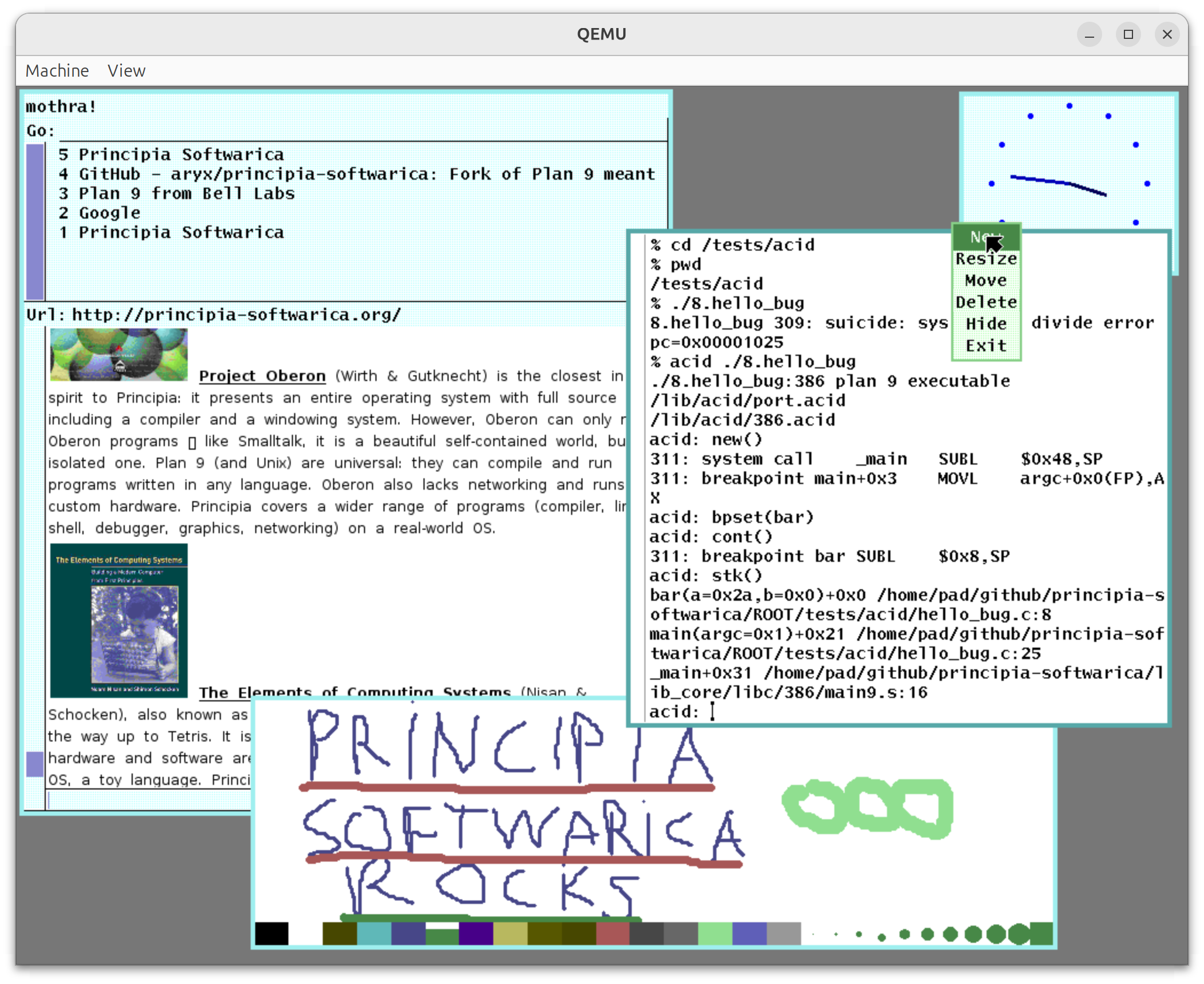
It is not as fancy as macOS or Windows, but in essence Plan 9 provides the same core services: a kernel managing processes and memory, a windowing system managing the screen, a shell, a compiler, networking, and graphical applications. Here it is running under QEMU:
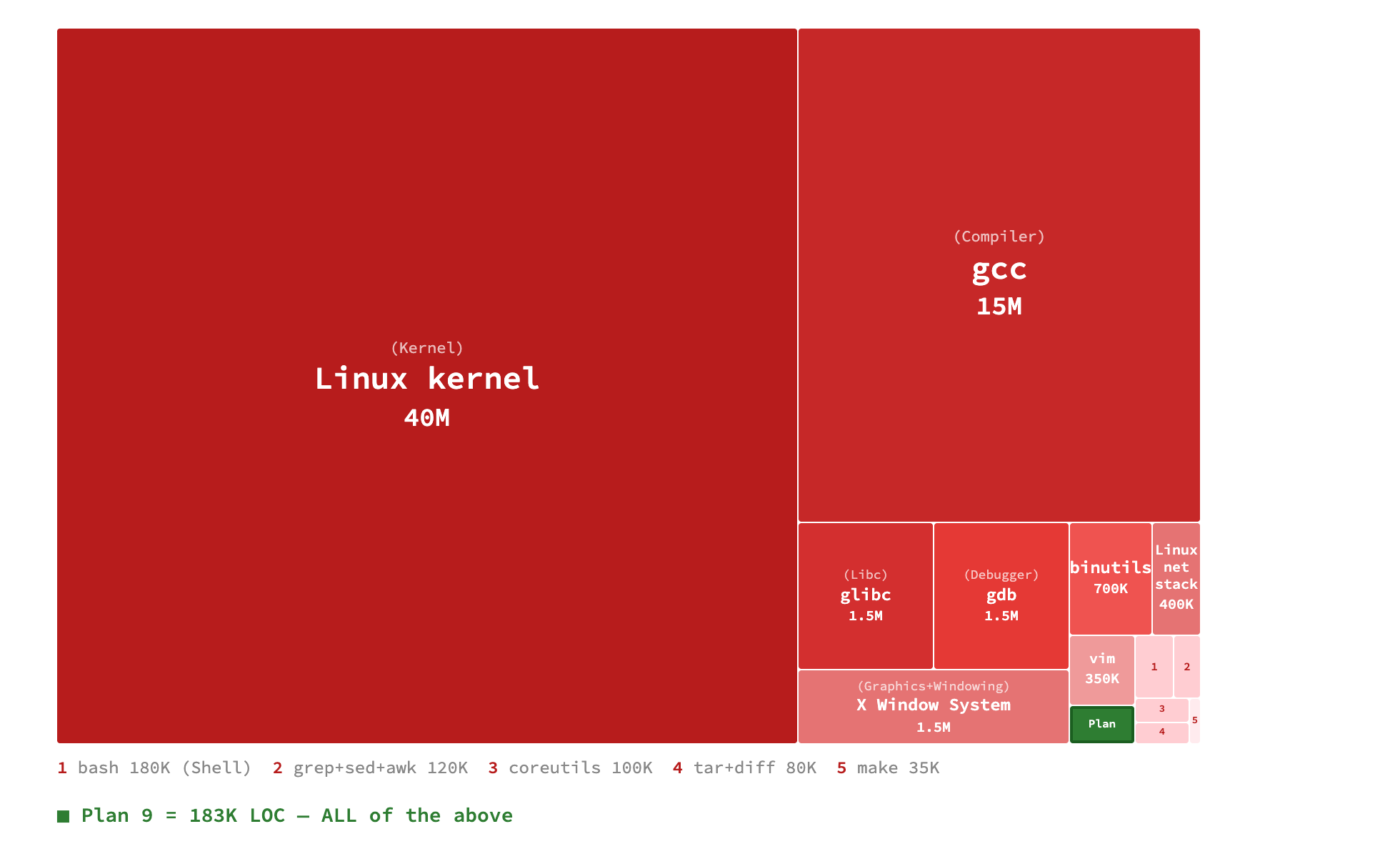
How small is Plan 9? The treemap below compares the size of GNU/Linux programs (in red) with their Plan 9 equivalents (in green). The entire Plan 9 system — kernel, compiler, shell, windowing system, and all the rest — fits in 183K lines of code, almost 2x smaller than just vim (350K). This is what makes it possible to explain every line in a book series.
Lines of code can be abstract, so to make things more concrete:
if each 400-page book covers roughly 12K lines of code,
Principia covers all of Plan 9 in about 15 books.
A single program like gdb would need ten times
more books, and gcc a hundred times more.
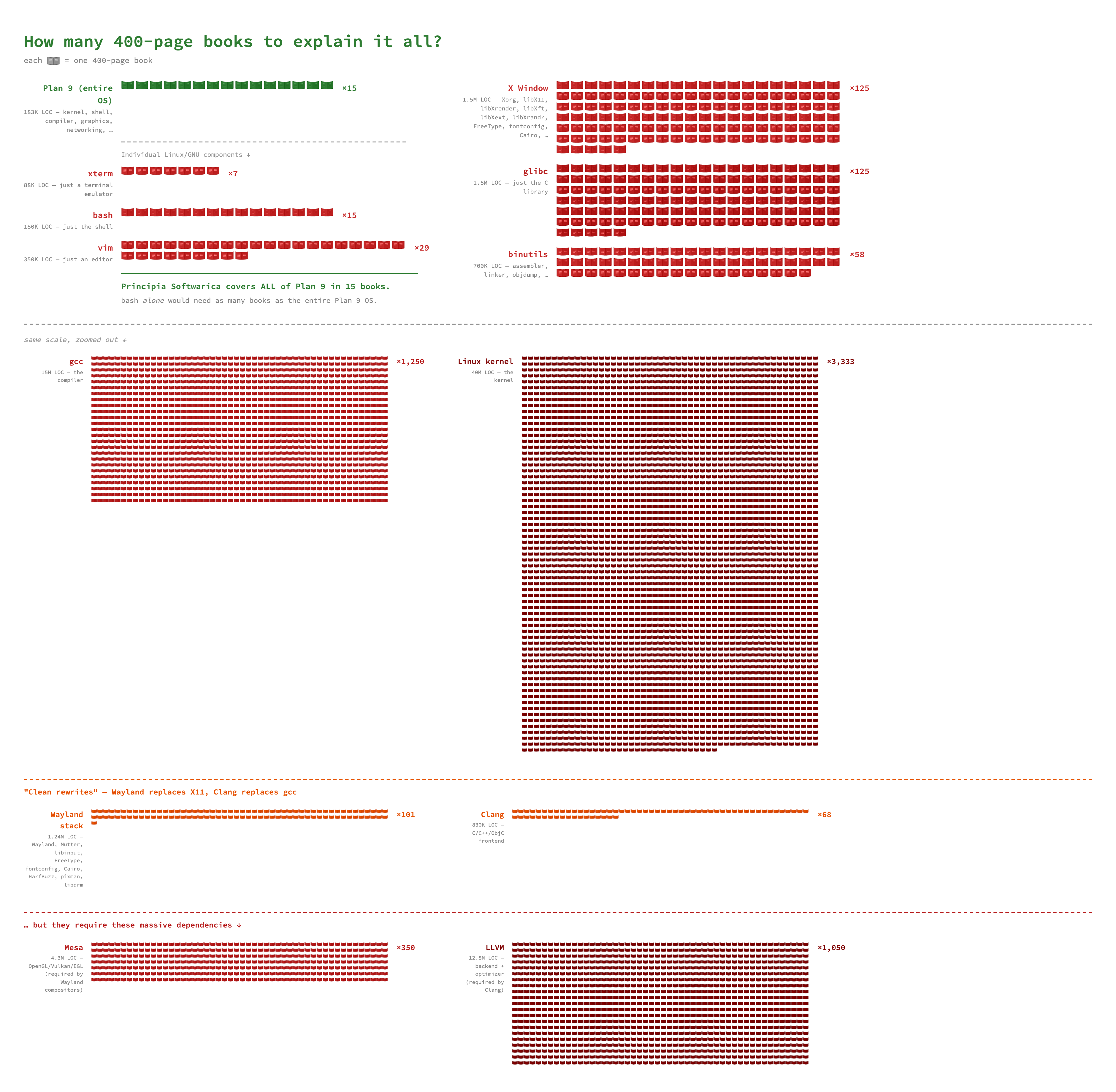
Even "clean rewrites" do not help: Wayland, the modern replacement for X11, is just as large. Clang, the modern replacement for GCC, is even larger. Rewriting does not make programs smaller — the Plan 9 approach of designing for simplicity from the start does.
You do not need to use Plan 9.
Understanding one small elegant OS gives deep intuition about
Linux, macOS, and even Windows.
Every system — kernel, compiler, linker, shell, editor, debugger,
GUI toolkit, network stack — solves the same fundamental problems,
and the essence of each problem is the same whether the code is five
thousand lines or five hundred thousand. Reading Plan 9's C compiler
gives you the vocabulary to navigate GCC. Understanding Plan 9's linker
in a single sitting makes LLD's relocation handling legible instead of
overwhelming. Seeing how acid reads symbol tables and
walks a stack teaches you what to look for in GDB. The same holds
for the shell, the build system, the widget toolkit, the TCP stack,
and the page fault handler: small, readable implementations give you
a working mental model you can carry into any large codebase. The
small system shows you what is essential, so when you face
the large one you can tell essential complexity from accidental
complexity — and stop mistaking the scaffolding for the building.
Moreover, many Plan 9 ideas are already everywhere:
UTF-8 was invented by Thompson and Pike for Plan 9,
/proc comes from Plan 9,
Linux namespaces (the basis of Docker and containers) come from Plan 9,
the Go language was created by Pike and Thompson with goroutines
inspired by Plan 9's libthread,
and the 9P protocol is used in WSL2.
The programs Principia explains —
grep, sed, awk,
diff, cc, ld —
are the same tools every programmer uses daily.
Same concepts, expressed 100x more clearly in Plan 9.
And you can use them for real: plan9port
brings the Plan 9 userland (grep, sed, awk) to Linux and macOS,
and goken9cc
lets you use the Plan 9 C toolchain from Linux, macOS, or Windows
to produce native binaries for those platforms.
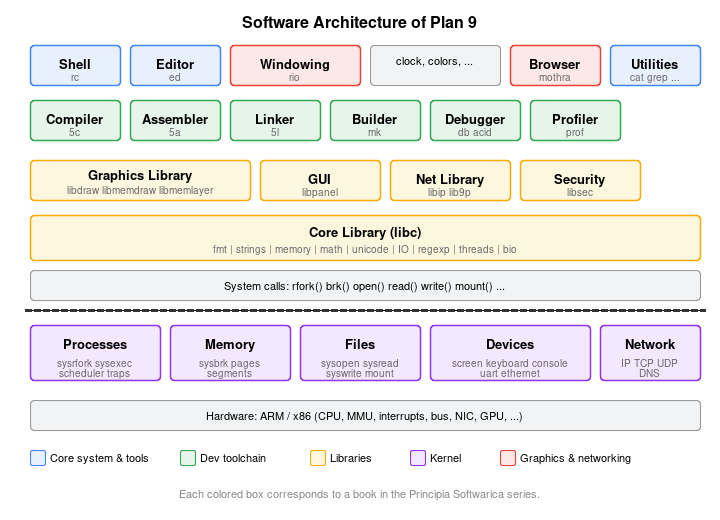
The diagram below shows how the different components of Plan 9 are organized, from applications at the top to hardware at the bottom. Each colored box corresponds to a book in the series.
See The Journey of ls
for a trace of a simple command through every layer of the system,
showing how the books connect together.
The source code for the Plan 9 fork used in Principia Softwarica is available on GitHub:
See Getting Started for instructions on how to build and run Plan 9 using Docker or from source.
After writing several of the books, I ported a handful of the programs to OCaml, a statically-typed functional language. The original motivation was to better understand the C code — porting a program to another language forces you to discover which parts are essential and which are accessory, and the bugs in the port reveal hidden subtleties in the original. OCaml is simply the language I'm most familiar with, and as it happens my favourite.
The ports have grown into their own project, XIX, with its own website and its own series of literate programming books covering the OCaml versions of each tool.
Principia Softwarica complements three classic books:
 |
Project Oberon (Wirth & Gutknecht) is the closest in spirit to Principia: it presents an entire operating system with full source code, including a compiler and a windowing system. However, Oberon can only run Oberon programs — like Smalltalk, it is a beautiful self-contained world, but an isolated one. Plan 9 (and Unix) are universal: they can compile and run programs written in any language. Oberon also lacks networking and runs on custom hardware. Principia covers a wider range of programs (compiler, linker, shell, debugger, graphics, networking) on a real-world OS. |
 |
The Elements of Computing Systems (Nisan & Schocken), also known as Nand2Tetris, builds a computer from NAND gates all the way up to Tetris. It is a wonderful pedagogical achievement, but the hardware and software are purpose-built for the course — a toy CPU, a toy OS, a toy language. Principia takes the opposite approach: it explains a real operating system with real code that runs on real hardware. |
 |
Computer Systems: A Programmer's Perspective (Bryant & O'Hallaron), known as CS:APP, is an excellent textbook that explains the concepts behind systems programming: memory layout, linking, virtual memory, concurrency. But it stops at concepts — it does not show the source code of a real kernel, a real linker, or a real compiler. Principia complements CS:APP by showing exactly that source code, explained line by line. |
99.9% of the code in the books was derived from Plan 9 fourth edition and was written by humans (Rob Pike, Ken Thompson, and many other Plan 9 contributors), and for the most part written more than 30 years ago.
What I did was essentially to reorganize the code using literate programming for ease of understanding, splitting the code in chapters, sections, subsections, appendices, and reorganizing again and again the literate programs to find the best way, the best order, the best separation of concerns in which I think you would more easily understand the code.
I also wrote many of the original explanations in many of the books
of the series
(the IWP9 talk is displaying
statistics pre-AI), but since March 2026 I have
also relied heavily on Claude Code to assist in writing those explanations.
The docs/scripts/ai_percentage.py script can be used
to display the lines of explanations (LOE) AI statistics.
Principia Softwarica is written by Yoann Padioleau, using Claude Code as an assistant, with code from Ken Thompson, Rob Pike, Dave Presotto, Phil Winterbottom, Tom Duff, Andrew Hume, Richard Miller, and Russ Cox.
Contact: yoann.padioleau@gmail.com
Similar to Principia Mathematica, which covers the foundations of mathematics, the goal of Principia Softwarica is to cover the fundamental programs.